Origins
Born in Pittsburgh
Harvey Fite is born on Christmas Day, the second son of carpenter Tom Fite and Floy Ruffner Fite. The family moves to Texas six years later.
Chronology · 1903 to the present
Twenty-five moments trace the journey from a Texas childhood and a traveling stage to one of America’s most extraordinary works of environmental sculpture.
The arc of the work
The filters isolate chapters without breaking the larger story.
Dates and claims are synthesized from Opus 40’s official history, Bard College, archival collections, National Register documentation, and published exhibition research.
Origins
Harvey Fite is born on Christmas Day, the second son of carpenter Tom Fite and Floy Ruffner Fite. The family moves to Texas six years later.
Origins
After work in a Houston law firm and evening law classes, Fite studies at St. Stephen’s College. Acting increasingly takes hold; in 1929 he joins the Maverick Theater near Woodstock.
Origins
While waiting backstage, Fite begins carving a discarded wooden spool. The immediacy of the act redirects his life toward sculpture.
Formation
St. Stephen’s—soon Bard College—brings Fite back to help develop its arts curriculum. He teaches drama and sculpture and helps establish the visual arts program.
Formation
Fite studies sculpture in Italy with Florentine sculptor Corrado Vigni, adding formal training to his increasingly direct approach to carving.
Formation
He buys a twelve-acre disused bluestone quarry in High Woods, Saugerties. That year the Carnegie Institution invites him to assist restoration work at the ancient Maya site of Copán in Honduras.
Opus 40
Fite begins building his home from salvaged timbers on the quarry’s eastern lip and starts clearing rubble. The work that will become Opus 40 is underway.
Opus 40
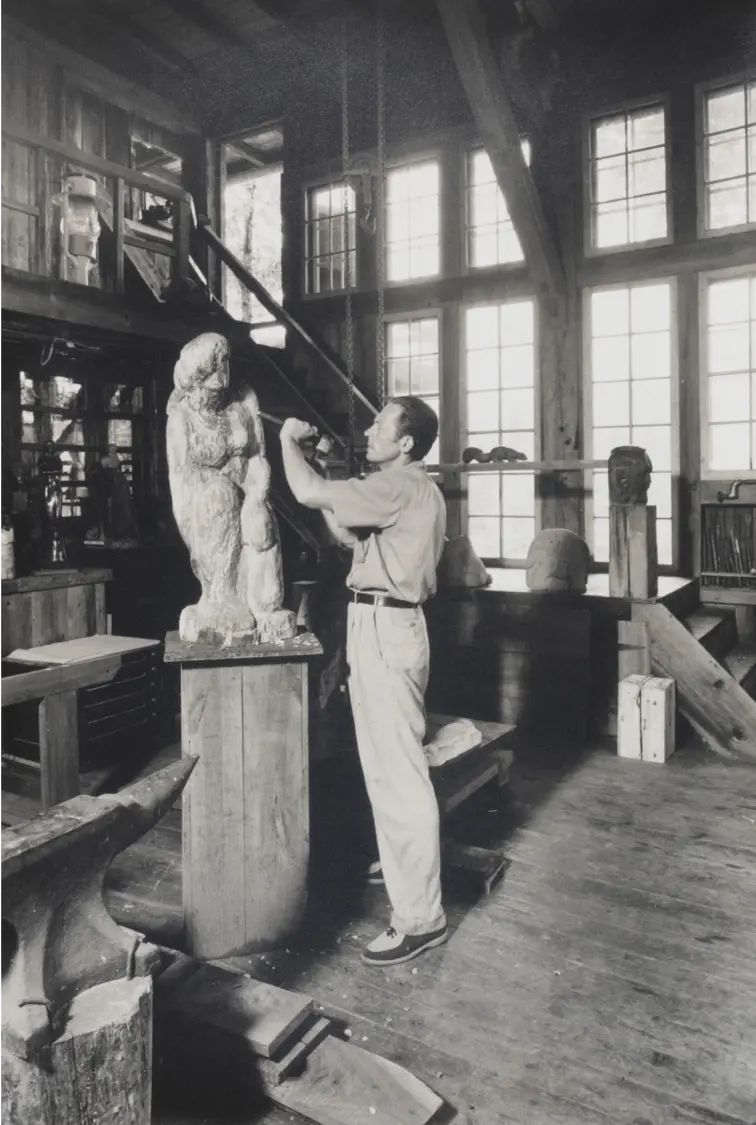
He begins one of his first large-scale bluestone figures while teaching himself the dry-stone construction methods that will shape the quarry.
Formation
Fite meets Barbara Fairbanks Richards in 1943 and they marry in 1944. He begins the monumental humanist group Flame, Tomorrow, Prayer, and Quarry Family.
Formation
Play, carved from amaranth, enters the Whitney Museum’s Annual Exhibition of Contemporary American Sculpture, Watercolors and Drawings.
Formation
Solo exhibitions at L’Obelisco in Rome and Galerie Raymond Creuze in Paris place Fite’s sculpture before European audiences.
Formation
Fite attends UNESCO’s first International Conference of Artists as an observer.
Opus 40
He discovers a fourteen-foot, nine-ton block of bluestone in a streambed and imagines it replacing Flame at the quarry’s center.
Formation
Fite builds a new studio in the woods, then travels in Southeast Asia, continuing a lifetime of studying ancient structures, ritual forms, and cultural traditions.
Opus 40
After two decades, the quarry gallery has developed its overall sweep of terraces and ramps against Overlook Mountain.
Opus 40
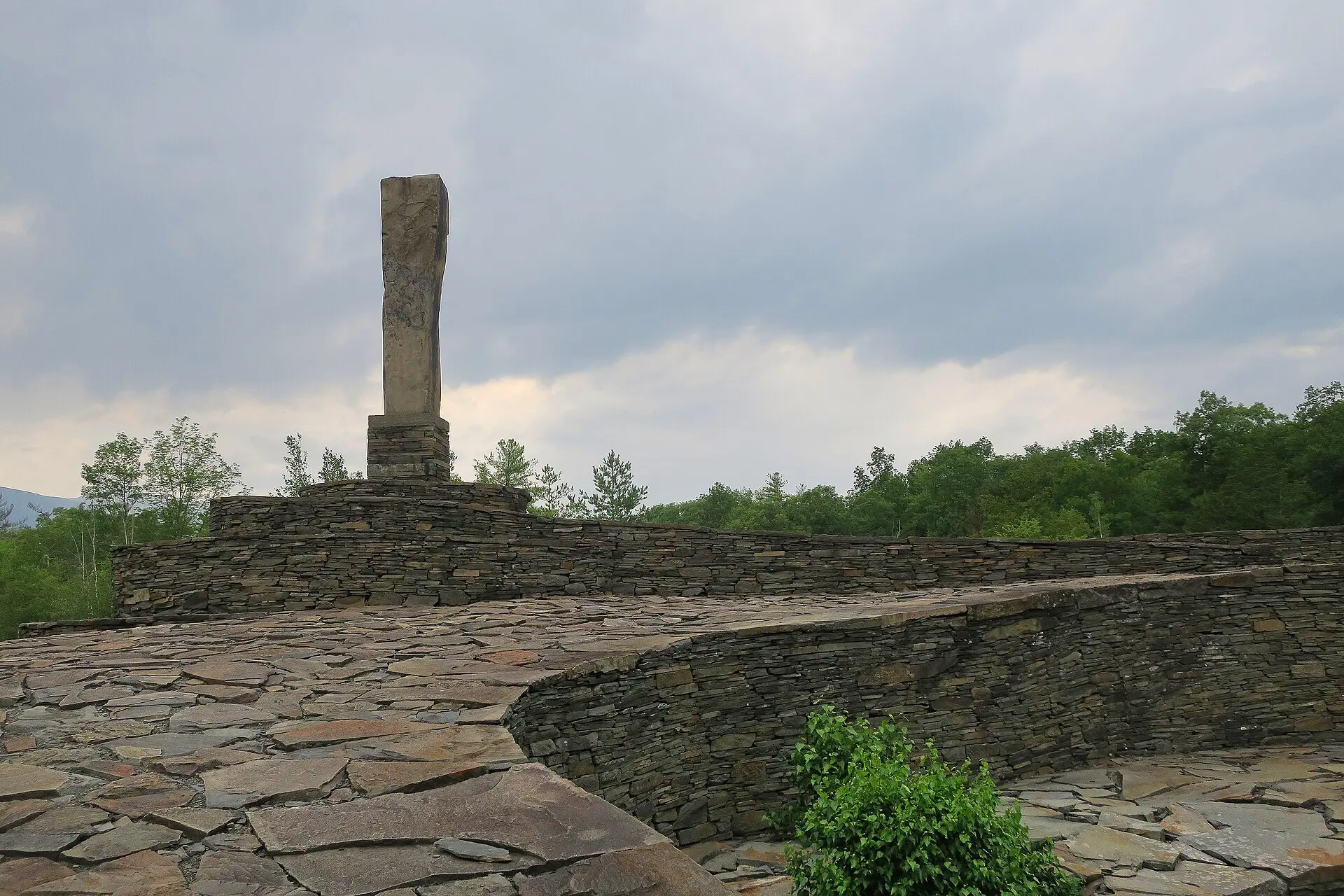
Fite raises the nine-ton central stone. Seeing it in place, he recognizes the quarry’s stonework as a unified sculpture and names the work Opus 40.
Opus 40
He begins an amphitheater on the northwest edge. On September 29, 1968, Opus 40 opens to the public for one day as a theater benefit.
Formation
After 36 years at Bard, Fite retires and gives increasing time to the quarry.
Opus 40
Fite creates a museum of quarry tools and regional industrial artifacts, honoring the workers and knowledge that preceded him.
Opus 40
On May 9, Fite dies at 72 in an accident at the quarry. The historic work stops that day after 37 years.
Legacy
The Hirshhorn includes Opus 40 in Probing the Earth. Barbara Fite establishes Opus 40, Inc., the nonprofit dedicated to preserving and sharing the site.
Legacy
After Barbara’s death, Tad Richards—raised by Harvey—and his wife Pat move into the Fite House and begin nearly four decades of family stewardship.
Legacy
Opus 40 is added to the National Register of Historic Places as a nationally significant work of environmental art.
Legacy
Opus 40 acquires Fite’s historic home, original studio, and archival material, reconnecting the domestic and monumental parts of his practice.
Legacy
Half a century after Fite’s death, Opus 40 continues as a museum, sculpture park, gathering place, and living study of one artist’s sustained vision.
A chronology is a framework, not a finish. Additional family records and object information will deepen this timeline as they are digitized and verified. Review the evidence