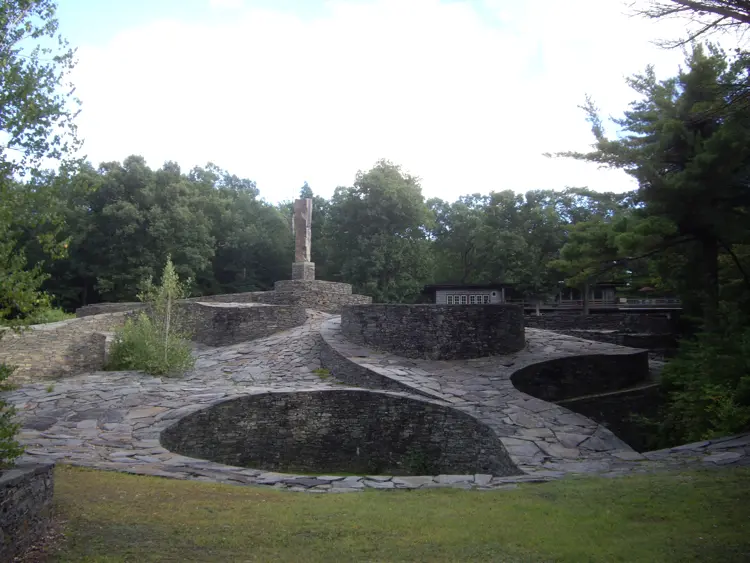
High Woods · Saugerties · 1939—1976
A quarry
made whole.
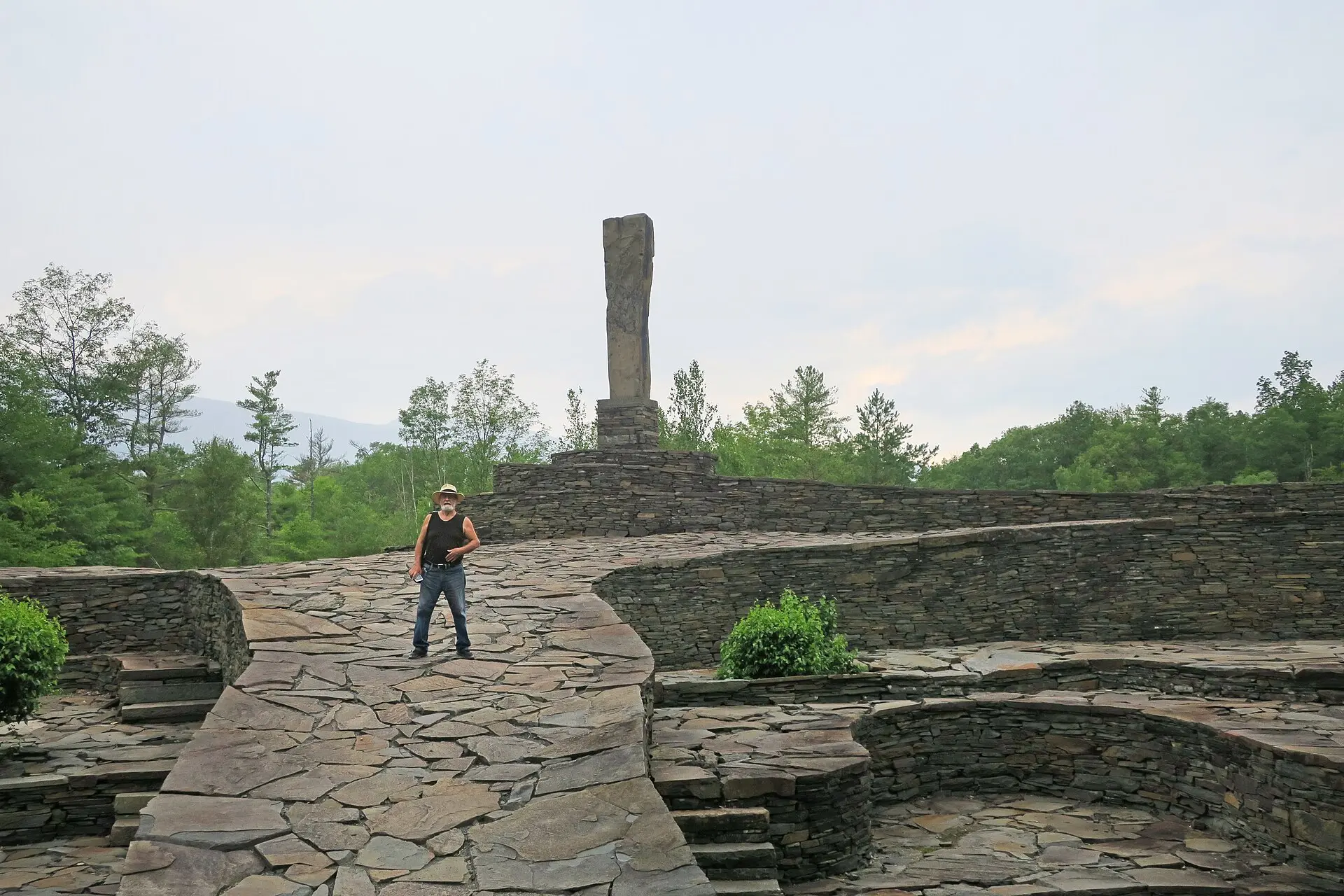
Opus 40 is not sculpture placed in a landscape. It is 6.5 acres of landscape composed as sculpture—built by Harvey Fite, stone by stone, over 37 years.
37years of continuous making
1939—1976
One person. Millions of pieces of bluestone.
Harvey Fite bought the abandoned quarry in 1938. At first, he meant to create an outdoor setting for large stone figures.
Clearing rubble led to a practical solution: stack the waste stone into walls. Walls became paths, paths became terraces, and terraces revealed a larger composition. Fite worked largely alone, fitting local bluestone without mortar and allowing the geology of the quarry to direct the design.
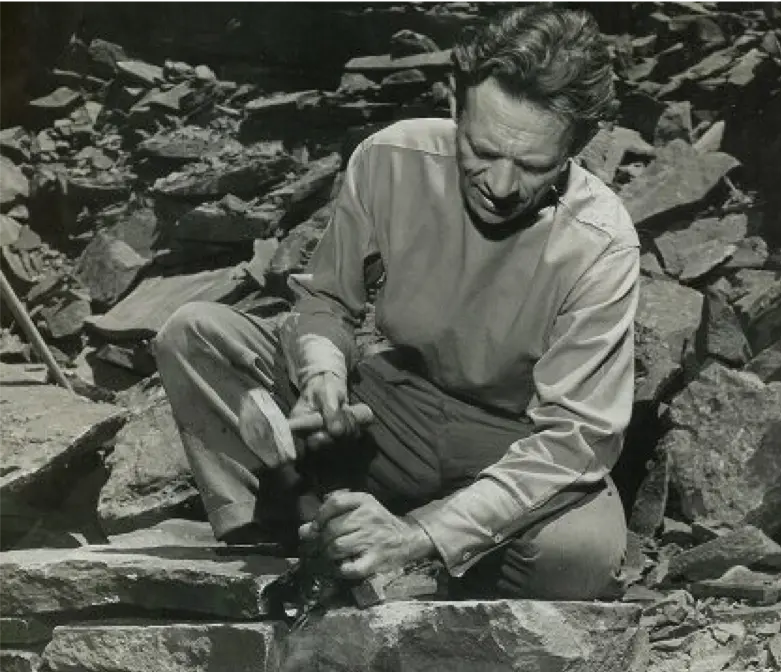
Fite fitting stone by hand · archival photograph
The method
No mortar. No blueprint.
Dry-laid construction depends on contact, gravity, friction, drainage, and judgment. Each stone must carry and distribute weight through the stones around it.
- 01Select by eye
Read shape, grain, fracture, and the gap to be filled.
- 02Lift and test
Move the stone into place; turn it until its weight settles.
- 03Lock the mass
Bind large pieces with smaller fitted stones, not cement.
- 04Follow the quarry
Let ramps, pools, ledges, and horizon guide the next move.
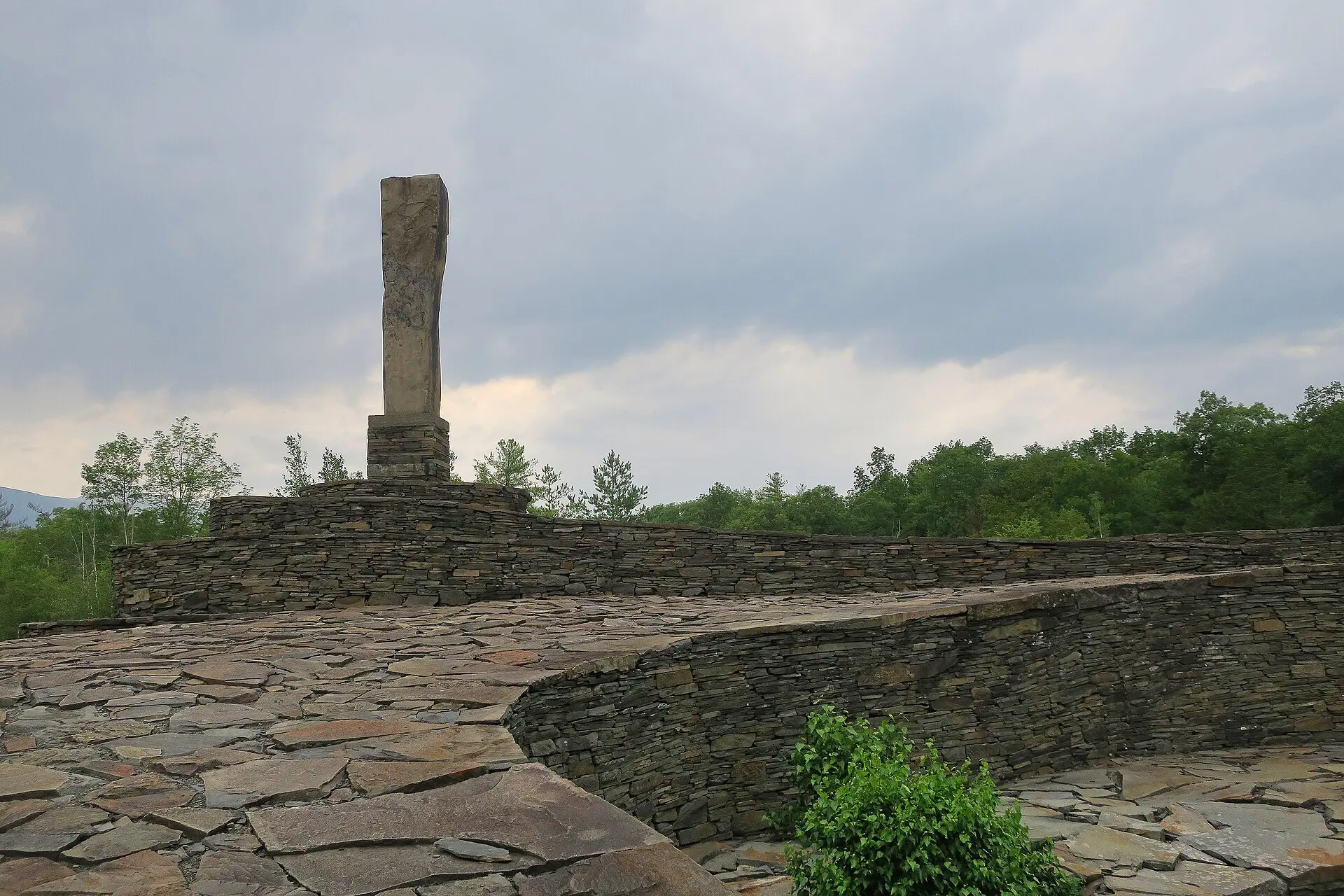
9 tonsraised into place · 1964
The turning point
The stone that made the whole visible.
In 1953, Fite found a roughly fourteen-foot block of bluestone in a nearby streambed. A decade later, he and Bert Wrolsen devised a way to raise it using logs, jacks, wire, an A-frame, block and tackle, and a pickup-truck winch.
Fite intended to carve the monolith. Once it stood at the quarry’s center, he understood that carving was unnecessary: the surrounding ramps and terraces had become the sculpture. The earlier human figures moved outward.
Follow the 1964 turning point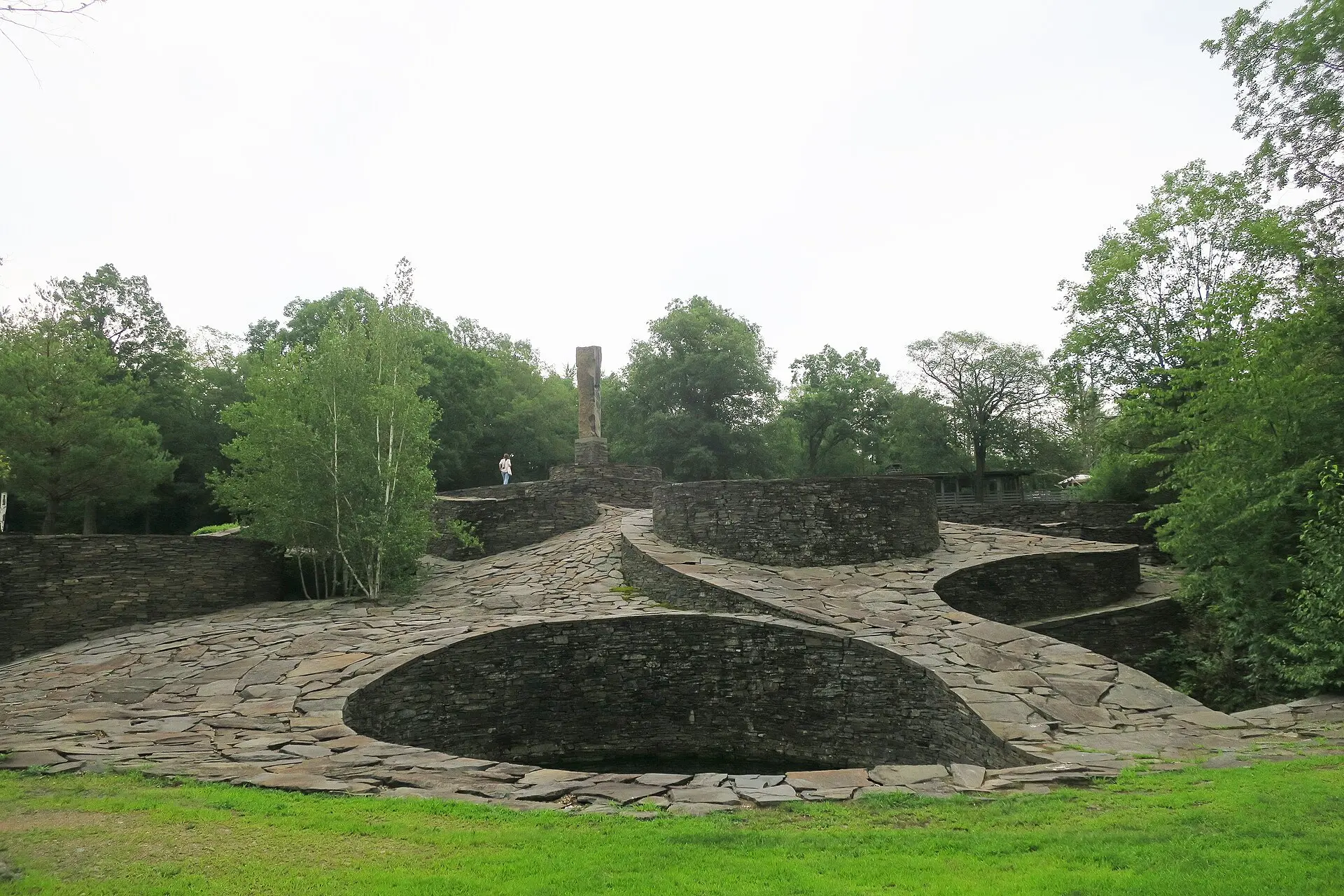
Not a pedestal for sculpture.
The sculpture itself.
Why here matters
The quarry belongs to a larger landscape.
High Woods
The rural Saugerties hamlet where house, studio, quarry, woodland, and family life converged.
Catskills
Overlook Mountain anchors the western horizon, giving the terraces a scale beyond their walls.
Hudson Valley
The river corridor connected Fite to Bard, Woodstock, New York art networks, farms, industry, and travel.
Bluestone country
The stone carries the labor history and geology of a region shaped by quarrying.
A total environment
More than the earthwork.
Today’s nonprofit property holds the sculpture within woodland, meadow, historic structures, archives, and a continuing cultural life.
About the present-day siteFite House
Built by Harvey from salvaged timbers; reunited with Opus 40 in 2023.
Quarryman’s Museum
Fite’s collection honoring regional quarry tools, rigging, and knowledge.
Woods and meadows
Trails and open land frame the stonework in changing Catskill light.
A cultural stage
Concerts, performance, education, walks, and gatherings animate the place.
See it in person
No photograph can explain the scale.
Opus 40 Sculpture Park & Museum is at 356 George Sickle Road in Saugerties, New York. Check the official site for current seasonal hours, admission, accessibility, tours, and events.